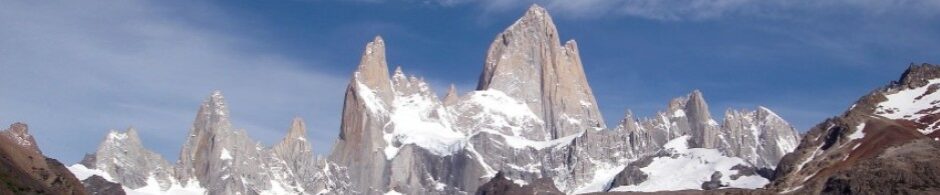
Cerro Torre and the bolts

There has been some discussion and a lot of spray on this issue on Supertopo. I’d just like to highlight some of the posts here so they don’t get lost in the bit universe. The thread is now 1200+ post and continuing.

The Torres
The Torres group

Jan 24, 2012 - 11:03am PT

Rolo this is very good news – particularly for someone who retains a long history with CT.

For those not then born I will explain.

Back in 1970 I organised an expedition to the SE Ridge. My team was a good one – Eric Jones (who later soloed the Eiger N Face), Cliff Phillips (who soloed the Piz Badille in 2hr35 mins in 1969)- the late Pete Minks (who soled the Walker Spur) and myself had climbed the Eiger N Face and filmed our ascent a year earlier. Swiss climber Hans Peter Tracsel who had climbed the Eiger in both winter & summer and Gordon Hibberd who was on the First Ascent of the Fortress in Chile, joined us.

Decades before the internet was even thought of, rumours were starting to filter through that Italian – Cesare Maestri had drilled his way up the SE Ridge using a compressor and pneumatic drill.

We had no idea what compressor meant. Why would you?

In 1968 Brit climber Pete Crew named the col on the SE arête – the ‘Col of Patience’ – with him were team mates Dougal Haston, Martin Boysen, Mick Burke and Argentinean – Jose Fonrouge. An all star team of the time.

On the ‘Col of Patience’ we dug the customary snow cave and waited and… waited. When fine weather came we climbed quickly up the ridge for several pitches to where Martin had dropped his bolt kit from their high point in 1968.

We were greeted by an old rope hanging downwards encased in ice like a giant gaucho’s boleadora. It dangled malevolently above our heads.

To our right we found the start of what became known as the first bolt ladder.

With clouds swirling around I filmed this via ferrate disappearing upwards.

The wall was utterly blank and even with modern climbing techniques I can not imagine this part every being climbed free – but dozens, if not hundreds of bolts were studded across this rising traverse. It was desecration on an industrial scale.

For 30 days the weather kicked in and gave us time to debate our predicament. There was no question that it was ruining our trip.

Do we use the bolts or not? At the time we were mindful of Messner’s “Murder of the Impossible” article on the over reliance of bolts and had not come half way around the world to climb an iron ladder in the sky – at least not with this team.

One day we were joined in our base camp in the forest by an Englishman Richard Cernesky – an Argentinean Peter Skvarca (who made the first ascent of Cerro Lautaro) and intriguingly an older man called Cesarino Fava.

At first the penny did not drop until Richard told me that Fava had been with Toni Egger and Maestri on the first ascent of Cerro Torre back in 1959.

Fava had his own views on the “Compressor” – he thought it was a waste of time but when I asked him about the original Maestri/Egger route from 1959 he clammed up.

“Why does everyone want to know about that climb”?

“Because – if its true, then it rates as one of, if not – the greatest climb of all time,” I replied more in exasperation than expectation.

No more conversation followed.

Maestri led two expeditions and was slow – incredibly slow but meticulously methodical. He helicoptered in a hut that was erected at the bottom of the mountain and air dropped in his supplies and secret weapon.

Now the reason for the slow progress was the weight of gear they were winching up the mountain. They were employing a weapon never before used by man against mountain. Up these precipitous heights, they carried 200 litres of petrol, oil, winches, ropes and a motor compressor – to drive a pneumatic drill. Come on guys this isn’t climbing – its scaffolding.

Historians may remember that great “CONQUISTADORS OF THE USELESS
French climber Lionel Terray, who back in 1952 was offered the assistance, on the first ascent of Fitzroy, by President of Argentina Juan Peron – of a helicopter to lift him to the summit.(to save him all the bother of actually climbing)

After our expedition Peter Gillman from the Sunday Times, Ken Wilson – Editor of Mountain Magazine and myself representing the BBC went to interview Maestri in Italy. (See Mountain magazine No 23 pages 30-37 Sept 1972 for the complete interview).

Using Alan Heppenstall as interpreter, I asked Maestri about his two climbs.

“Why the compressor?” I asked.

Maestri told us, “I took it because I calculated I might have to hammer in 1000 bolts. Of course this would have been an endless process by normal means”.

He went on to explain that this decision had not presented him with any philosophical problems:

“I have spent most of my life trying to push forward the limits of climbing and climbing techniques in general. I did this with solo climbing – I have soled Grade 6 routes in both ascent and descent. When all the other expeditions started failing* on the South-East Ridge of Cerro Torre, despite the fact that they all compromised of good climbers, it seemed to me that the route must be impossible by normal means, so I decided bolting would be necessary.”

* all other expeditions? Only the Brit 68 one that I know of? –it seems to be a case of making the story justifying the facts.

Back on the SE Ridge our dilemma continued. The weather was not kind that season and with deep misgivings we climbed the long bolt ladder going up into the mists. We eventually reached the headwall and saw the bolts disappearing upwards towards the summit.

We had had enough. I returned to the UK and made my film for the BBC titled “CERRO TORRE – THE RAPE OF A MOUNTAIN”.

To my complete surprise when we spoke with Maestri, he told us that he had not actually stood on top of the mountain – justifying it by claiming that the top of the headwall was enough and that the summit mushroom would one day blow away as it was not part of the mountain!

After all his efforts – after spending 13 million lire paid for by Atlas Copco makers of his infamous bolt gun – and with expeditions in both summer and winter – he had not actually stood on the summit.

In 1973 Eric Jones, Irishman Mick Coffey and myself crossed the Heilo Continental Ice Cap – made the second ascent of Cerro Lautaro and made the first ascent of another volcano that we named Cerro Mimosa after the ship that brought early Welsh settlers to Patagonia in 1865.

The Ice Cap Western side of Cerro Torre thrusting out of a sea of foam is surely one of the most beautiful sights on planet earth but after spending 54 days on ice and running out of food we ditched our sledges, missed the Pass of the Winds – the exit to the Pampas and went the longer laborious route all the way down the Viedma Glacier to safety, where an asado, gratefully supplied by a local gaucho and a lorry home were our reward.

In 1974 I organised a third trip, this time to Torre Egger the smaller satellite to Cerro Torre named after Toni Egger. We were not successful and changing direction in the last days of the trip climbed the “Innominata” – (literally mountain with no name).

In memory of an Argentinean who had shared out camps earlier in the trip but had one day failed to return – we renamed it Aiguille Rafael.

Earlier that year of 74 we met another Italian expedition led by Casimiro Ferrari. They were attempting Cerro Torre from the western Ice Cap side.

Casimiro had served his apprenticeship with Carlo Mauri and Walter Bonatti a couple of years earlier and was well prepared for the biting winds blasting the Ice Cap. After six weeks of storms, four of the team – Daniele Chiappa, Mario Conti, Casimiro Ferrari, and Pino Negri, reached the summit and made the First Undisputed Ascent of Cerro Torre.

At the Trento film festival in 1976 I met Casimiro Ferrari.

He told me that the ice cap was a desperate place and that just as his team was running out of food, he had discovered two sledges which, on close inspection turned out to be British, and had revealed 15 Mars Bars which in turn, kept his team alive.

Rather embarrassingly I explained that the sledges were mine and that as the Mars Bars had been soaked in petrol they had been inedible.

After a year on the ice cap the petrol had evaporated and the Italians changed their diet to British cuisine.

It’s a lovely thought that in a small way we had assisted in the first ascent of Cerro Torre.

In Trento, Casimiro asked me who I thought had made the first ascent of Cerro Torre, I stared at him and said, “I am looking at him”.

But what a mess Maestri left.

A highly questionable first ascent in 59 which few now believe stands up to scrutiny since Rolando Garibotti, Ermanno Salvaterra, and Alessandro Beltrami climbed the same route as described by Maestri but found no evidence of earlier passage.

Then the ridiculous compressor ‘near miss’ route of 1970 which proved nothing.

But perhaps the most saddest piece of Maestri’s legacy is – denying his fellow Italians their rightful place in history.

Now that this ridiculous via ferrate has been removed, an ascent of Cerro Torre will have meaning once more.

It will take its rightful place as one of the world’s most inaccessible summits.

Please let no one put back the bolts.

Leo Dickinson Jan 2012

Cerro Torre from the Silla

Jan 20, 2012 - 02:56pm PT

It was january 16th., 1965. If interested, here follows the real cronology and facts about the Compressor Route on Cerro Torre that began when with Fonrouge we were at the top of Cerro Fitz Roy via the Supercanaleta in the second absolute ascent of this mountain. Because this beatiful and exigent mountain merits the most from climbers we did it in alpine style, mostly in simulclimbing, without fixed ropes, siege attacks or artificial weaponry. Behind and below us the fantastic Cerro Torre in clear skies showed with brightness his beatifull icy shape.

Time afterwards – I guess it was 1966 or 1967 – at a table of a bar in Buenos Aires with Douglas Haston, Mike Burke and (was there also Martin Boysen?) we were dreamming about giving a try Co. Torre thru the Southeast Ridge and our fingers traced an ideal line over the SE ridge of one of our Co. Torre’s photos we took from Fitz Roy summit.

Sometime after, Fonrouge joined the British team that arrived high in this line but misteriously stopped before the icy towers. Wonder how the famous expedition rawplug dissapear…? Don’t know by sure, but I always remember the conversation I had with Fonrouge at home – and his decision – after our meeting with Haston and friends at the bar that we’ll never use an spit. And I also said thst…to give a try to this empoisoned mountain by Maestri’s 1959’s claim was a nonsense having manny other virgen summits to make.

Later, in january 1970 Maestri asked to meet us in Buenos Aires when he decided to make an attempt to the Southeast Ridge and looked for details of the line but didn’t mention the use of a compressor and gave us the idea to try the climb by fair means. As it is known they didn’t make the summit this time. Weeks after their return I was in Italy for business reasons and he invited me to Maddona were we spent some time talking about his programmed new intent to Cerro Torre in the following southamerican 1970 winter. No words were said about the use of a compressor for drilling holes to plug spits. Upon his return from patagonia having used the compressor and claiming for his new line on the SE ridge – and also mentionning that the top mushroom was not the true summit-, more doubts appeared about his 1959’s line statements.

Living for professional reasons in Milan-Italy, since late 1973, I had many contacts with the Ragni Group and got an idea about the national battle around Cerro Torre’s Maestri claims at the time of his public statement directed to the Ragni Group saying that his climbs were discussed by whom couldn’t climb Cerro Torre. Casimiro Ferrari’s answer to Maestri was that the Ragni Group climbs mountains that can prove they climb and start to organize another attack to the west face of Torre. As we know today they made the true first ascent of the mountain. More recently Garibotti, Salvaterra and Beltrame proved that no one had transit before the line claimed by Maestri.

In my name and the others that resign the dream to climb for first this fantastic mountain I claim for our rights to delete from the walls of Cerro Torre all the remainings – compressor inclusive – of the rape made by Maestri in the 70’s and I think that no one – for any reason – can have more rigths than ours.

Carlos Comesaña

Posted in Blogging, Patagonia | Leave a comment

Norway winter climbing

Norway has been a black spot on my mountaineering map. It’s a big country with loads of mountains and it’s situated relatively close to my home but I’ve rarely visited there. I’ve tried to gather some information about climbing there but untill now I can’t have said I’ve known much about Norway. In 2005 I was ice climbing for a week in Rjukan and in 2008 we did the winter ascent of Ultima Thule on Blåmannen with Saku and Adrian but that was just about it.

Mongejura: South Pillar (Sydpilaren) (6a+, 900m), November 13th, 2010

Last winter the situation got better as we visited Romsdalen in November with Johannes Kärkkäinen. That trip we tried the South Face of Mongejura (6a+, 900m) and climbed a couple of hudred of meters of an ice fall called Olmåa (WI4, 900m). We didn’t top out either of them but they both were good fun. I liked more the Mongejura and Johannes liked the ice climbing.


The 2010 trip was my first weekend alpinism attempt with loads of planning errors but it was a good start. We had a gas stove and had big problems with finding a proper gas canister. We had too little time and we also underestimated the driving distances of Norway. Nevertheless we managed some climbing and got the first glimpse of the very long winter climbs of Norway.

Romsdalen: Ølmåa (WI4, 900m), November 14th, 2010


This year I had bought many new guide books for Norway and I had invested loads of time on researching what else would be fun in winter. I was now climbing with Teppo Saarenpää and we both like going big on mixed terrain. We wanted something with both WI4/WI5 and M4/M5. If possible with 1000m or more altitude difference.

Romsdalen I knew had this but the weather had been above freezing all winter and we had to think something else. We thought Romsdalshornet (1550m) could have been a good alternative since it was higher up but the short term weather forecast looked bad and it was no option. Another big motivation for us was the Storen in Hurrungane but the weather didn’t look good there either.

With no knowledge of any other good objectives we agreed on an ice tour with three or four long ice falls with short approaches. We planned on doing the Jukulkula near Otta first, then Langåni (WI5, 250m) near Vang and finally Grøtenutfossen (WI5, 250m) in Hemsedal. If we had time left we would visit Rjukan before flying back home at 6 PM on the last day.

Otta: Jukulkula (WI4, 270m), January 6th, 2012

Jukulkula was just as we wanted. Fairly steep all the way and sustained for the grade. We both thought it was slightly harder than the Trappfoss (WI4, 200m) in Rjukan but all in all very similar. The parking spot also made a very nice bivy spot. With the short approach there was no need for an alpine start either.


Once we got down from the climb and checked the weather the plan changed instantly. They promised one good day for Hurrungane and there was no question what we would do. We started driving towards Turtagro. We both thought we had done enough ice climbing for this winter and we wanted something with little bit of more adventure in it.

Hurrungane: Skagastølstindane, January 7th to 8th, 2012

Prior to our trip I’d read something about Hurrungane but I couldn’t say I actually understood anything about it. I had a hunch the Sognefjell mountain road was closed during winter and that was the case. I had also read somewhere the road from Songdal was open to the Turtagrø Hotel (884m). Other than that we had no idea how the approach or the scenery would be.


We arrived at Turtagrø around 10 PM and set in for the night on the parking lot. In the morning we had no hurry since had to wait for light to get some clue about the directions. With the help of a couple of photos and books we reasoned the right direction and started hiking. Since we had packed the gear for ice climbing we didn’t have either skis nor walking poles with us. Once we started hiking we knew this was going to be a tough day. Snow till the knee on top of crust. Every fifth step the crust broke under our weight.

After about 3 hours of hiking it was 3 PM. It was not really dark but we knew we weren’t going to make it to the Hytta på bandet (1758m) before dark. What would have been a three hour hike in summer had taken us three hours and we were not even half way. And we were totally knackered. Three hours in deep snow is quite a different story than three hours on summer trails. We thought about bivying right at that place but decided to continue. After about 100 meters of hiking we saw something we thought we would never see in such a place. A very well kept red Norwegian house. We took a look at the name on the door and it said “Norsk Tindeklubb”. After a very short conversation we decided to bivy. Later we found out the hut is called Skagadalshytta (1350m).

Next morning we woke up with clear blue skies. It was very cold and putting on shoes was hard work. The fingers were freezing after few seconds of bare hands exposure. Knotting shoe laces took me at least three tries before I decided I just have to tough it out. It was probably something in the range of minus 15 to 20 celsius and quite a bit of wind. It was clear we weren’t going to top out Store Skagastølstind (2405m) with these conditions and our physical condition. It seems browsing the web or playing with an Ipad doesn’t help much with hiking in deep snow.

With no real objective we chose to get as high as possible with as little work as possible. We had a look around and went for Nordre Skagastølstind (2167m). Just below the summit boulder I got to touch the rime which was the highlight of the trip for me. I don’t know if does it but I hope it transforms into mushroom ice with a couple of freeze-thaw cycles. Next time we’ll be in Hurrungane later in the season. Most likely in late February.

Posted in Alpine Climbing, Scandinavia | Leave a comment

Sunny Riglos in Spain!

Riglos – what a place! The food is good, the climbing is even better and the three course dinner called “menu del dia” – phew! This place I will definitely visit someday again! On the last night after having a few pints of beer and a bottle of wine Jari said Riglos must be the most perfect autumn spot. Good steep rock and demanding routes. Very much like climbing in the Dolomites but lower down and with better temperatures. And the approach is 15 mins or less.

Mallo Pison: Murciana (6c, 300m), October 28th, 2011

On the day we arrived we climbed the Alberto Rabada on Mallo Pison. The route had some very straight forward climbing with a very evident line. The line could be seen half a kilometer from the face since it was all white. The wall is so overhanging it never rains on this route…

In the Spanish topo we thought it said the route was fully bolted but in my opinion some additional pro like a set of nuts could have been useful. For example the first pitch had 6 bolts for 50 meters or so. After the first pitch it was more relaxed, though.

Mallo Fire: Rabada-Navarra (6b, 300m), October 30th, 2011

For our second route we chose something more adventurous and got on the Rabada-Navarro on Mallo Fire. Technically the route should have been easier but there was one thing that made it a little more demanding. This one didn’t have shiny bolts like the most frequented routes have.


Most hard pitches had an 8mm spit protecting the crux move but the easier sections had only odd kevlar threads with different colors. Combined with the suspect rock and difficult route finding the route was much more interesting than the previous one. The route finding was always a challenge since there weren’t any chalk marks. Most often you just had to run it out at some direction and eventually an old rusty pin or an old thread would pop out somewhere. Sometimes it was one pitch left and sometimes one pitch right but in the end you could always find some pro. All in all it’s a stellar route if you like this type of climbing and thus highly recommended!

With many detours we eventually ran out of time and had to abseil down. We figured it was better abseiling down with daylight than pushing it to the top in the dark. The route gave us very much the adventure we were looking for, though.

Below are few pics with topos found on the wall of bar El Puro. If you find them useful please support the bar buying menu del dia perhaps. The prices are very reasonable and I can guarantee you won’t be disappointed.

Posted in Europe, Sport Climbing | Leave a comment

Dolomites, Italy

I had a four day weekend in Dolomites in the beginning of October 2011 with Teppo Saarenpää from Turku. The original plan was flying to Milano and climbing whatever in condition. We discussed Marmolada, Tre Cime, Val di Mello and Valle del Orco among other options. We even discussed driving all the way to Calanques if everything else was out of condition. But this time we didn’t need to utilise any of the plan B’s. Two days before the trip Teppo asked me if we had won the lottery. The prognosis was isotherm 3800 and blue skies for Dolomites for four days! It was more or less summer conditions and this was the first weekend of October…

Our plane landed in Milano at 22.30 and we started driving towards Marmolada one hour later. Somewhere after Trento we put up the tent and in three hours we were on the road again. Once we arrived at the Marmolada parking it was already 9 AM. One thing was sure – we weren’t going to climb up the hill and walk down again in one day. After all Marmolada was supposed be about 800 meters of steep limestone. As we couldn’t see any such wall from the parking spot we guessed it would be a fair bit of walking before the climb, too. Understanding the circumstances we packed bivy gear with us and planned a bivy on the mid way ledges.

Marmolada: Vinazer (6+, 800m) – October 1st, 2011


OK, it didn’t go as we planned. We got a big kick on our fat butts on a mere UIAA 6+ (French 6a) pitch about 200 meters off the ground. We had a topo which said the variation pitch was supposed to be 6+ but it sure was a fair bit harder. Actually it was harder than any of the pitches we did later on the trip and at home I eventually found out we did the crux pitch of Olimpio 6c+. In any case with bivy gear it was hard enough to get us worked out and we lost too much time. We reasoned being too slow and abseiled down. We were also quite worried about any other 6+ “sandbags” higher up. Had we known we did something harder than the crux of Tempi Moderni we might have made different decisions…

Cinque Torri: Via Finlandia (7-, 140m) – October 2nd, 2011

The next morning we woke up at Passo di Falzarego with no real plans. We knew the Finnish route Via Finlandia by Matti A. Jokinen was supposed to be somewhere around. We browsed through the books decided to have a go on that one for historic reasons. We were also slightly distressed about the grades and wanted to check our level before trying anything big again.


Via Finlandia was very nice climbing and the grading was normal. We “accidently” climbed a 7+ pitch on the right side wall and that felt ok, too. This boosted our confidence again and we drove towards the Tre Cime. On the way there we stopped for some pizza and cakes in Cortina.

Cima Piccola: Spigolo Giallo (6+, 380m) – October 3rd, 2011

The alarm woke us at the parking at 4 AM. We were preparing for Comici on Cima Grande but then I had second guesses about the weather. Just before going to sleep we’d met two climbers from Munich who said Brandler-Hasse had been wet the previous day. Teppo said he ain’t going to suggest not going there and I said the same. Then I reasoned if we skip “what would be cool” and focus on “what would be nice” I’d like to climb in the sun in stead of shivering in some shady waterfall on the north face. Teppo said he might have problems of “giving up” if we went back home without trying. Then I spoke about “downshifting” and doing what you actually want to do instead of what you’re expected to do and he started laughing. Few moments later we decided on climbing the Spigolo Giallo and continued our sleep for three more hours.


Spigolo Giallo was stellar climbing and we were both very happy about our decision. The climbing was somewhat runout in the middle part and slightly runout higher up but it was never too runout on the hard sections. The pitons were generally speaking ‘ok’ although some were spooky. For me the most memorable lead was the pitch after the long traverse left. It was steep and the pitons were old. If it had been any less steep it would have been utterly dangerous but now it was exposed climbing, complex route finding, good holds and a potentially huge but clean fall. It really can’t get any better than that!

All in all the climbing went smoothly although there were some 6+ pitches and three parties ahead of us. We started the route at 10.45 and topped out five hours later which was more or less the guide book time. The climbing was as sunny and relaxed as we reasoned. Maybe next year we’re more into climbing something cool again but this time Spigolo Giallo was spot-on decision… =)

Posted in Europe, Sport Climbing | Leave a comment